The CUE Method FAQ
Common questions about estimation with the CUE Method.
New to the CUE Method? The Estimation Problem That Led Me to the CUE Method explains where the method comes from, and How to Run an Estimation Session using the CUE Method walks through a session. This page answers the questions that come up most often.
The Basics
What is the CUE Method?
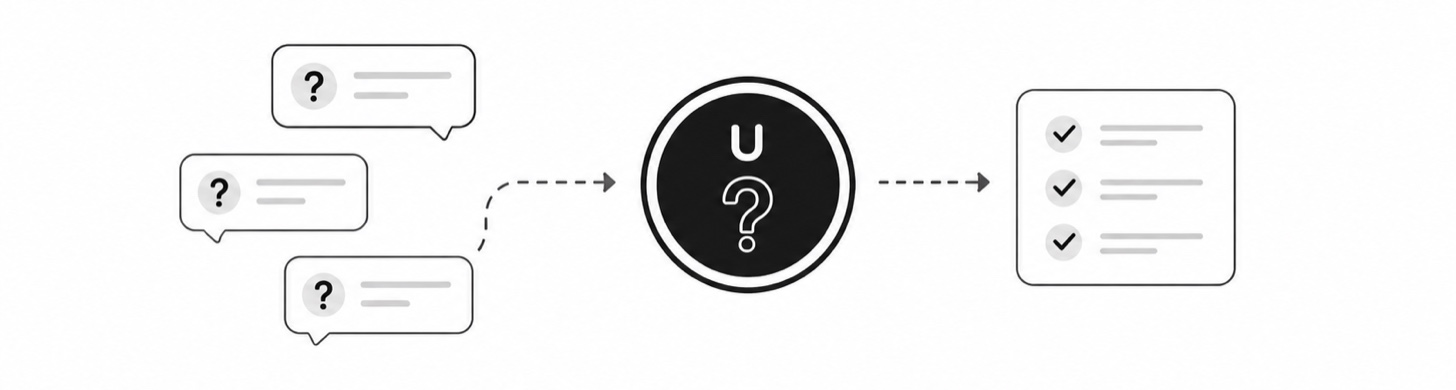
The CUE Method is an Agile estimation method built around Complexity, Uncertainty, and Effort, with uncertainty acting as a gate that determines whether estimation should continue. Uncertainty is scored first. If it is too high, the team stops estimating and creates a Spike instead of producing a story point.
Why does uncertainty get special treatment?
Because missing knowledge is different from known difficulty or volume of work. When a team does not yet understand what the work involves, any estimate of complexity or effort is unreliable. The CUE Method makes that lack of knowledge visible and actionable.
How is uncertainty different from risk?
Risk and uncertainty are related, but they are not the same. A risk is something the team can identify and assess even though the outcome is not certain. Uncertainty exists when the team does not know enough about the work to make that assessment reliably.
The CUE Method does not ignore risk or assume that it is part of Complexity or Effort. Known risks can still be considered through the team’s existing estimation and risk practices. Uncertainty gets special treatment because too much missing knowledge can make the story premature to estimate.
Is the CUE Method a replacement for Planning Poker or story points?
No. The CUE Method is designed to work with existing practices. Many teams use it simply as an Uncertainty Gate and then continue with their normal estimation method. Scoring all three factors is optional.
Scoring and the Gate
What is the Uncertainty Gate?
It is the uncertainty threshold the team agrees on before using the CUE Method: the point at which there is too much unknown to continue estimating. When uncertainty reaches or exceeds that threshold, the team creates a Spike instead of assigning story points.
How do we choose the uncertainty threshold?
The team decides. What matters is that everyone agrees on the threshold and applies it consistently, not the number itself. The sample working agreement in How to Run an Estimation Session using the CUE Method uses 8 on the Fibonacci scale, which is a reasonable place to start. Adjust it later if experience shows a different threshold works better for your context.
Do we have to score Complexity and Effort separately?
No. You can use the CUE Method in a minimal form: score only Uncertainty and apply the gate. If the story passes the gate, continue with whatever estimation method you already use. Full three-factor scoring is useful when the team wants more structured discussion.
How do we combine the three scores?
The simplest and most common approach is to take the arithmetic mean of the three scores, then use a quick confidence vote.
- High confidence → round to the nearest Fibonacci number
- Lower confidence → round up to the next Fibonacci number
Some teams discuss the three scores and then run a final Planning Poker round instead of averaging. Both approaches work if the team is consistent.
What if the team is split on the Uncertainty score?
When the team is roughly evenly divided on whether the story is above or below the threshold, treat it as above the threshold and create a Spike. Favor learning when the room is divided.
Spikes
How many Spikes can we create for one story?
Maximum of two. Before creating a second Spike, the team should believe it is likely to bring uncertainty below the threshold. If uncertainty is still high after two Spikes, return the story to the Product Owner for further refinement or splitting. Do not create a third.
What if a Spike uncovers even more unknowns?
That is common. The Spike rules still apply: do not automatically create another Spike. First decide whether a second investigation is likely to reduce uncertainty enough. If not, send the story back for refinement.
Adopting the CUE Method
Should every story go through the CUE Method?
No. The CUE Method is most useful when the backlog regularly contains significant unknowns, unresolved dependencies, unfamiliar technology, or unclear requirements. Teams that already have high clarity and predictability usually do not need it for every story.
How do we add the CUE Method to our working agreements?
Here is sample language you can adapt.
- Uncertainty Gate. We treat an uncertainty score of 8 or higher as too high to estimate.
- Definition of Ready. A story is ready for estimation only when its uncertainty score is below the agreed threshold, or a Spike has been completed that brings it below.
- Spike Rules. Spikes are time-boxed. Maximum of two Spikes per story. A second Spike requires confidence that it will reduce uncertainty below the threshold.
What’s the fastest way to start?
Start with only the Uncertainty Gate for two or three sprints. Keep your existing estimation method. Add Complexity and Effort scoring later only if the team finds the extra conversation valuable.
Where to Learn More
- Origin story and rationale: The Estimation Problem That Led Me to the CUE Method
- Practical how-to: How to Run an Estimation Session using the CUE Method